Why Do Door and Window Hardware Need Certifications?

Time:2026-09-28 Author:Madeline
0%

A handle may look simple. Its failure can leave a fire door unsecured, a window difficult to open, or a building envelope poorly sealed. Certification provides documented evidence that products have been tested against defined performance requirements. It does not make every product suitable for every project. The right standard depends on the hardware type, intended use, building design, and destination market.

The stakes are practical. NFPA’s U.S. Fire Loss in 2023 report estimated 1.389 million fires and 3,670 civilian fire deaths in the United States. These figures do not show that hardware caused those fires. They do underline why dependable door operation and tested fire-door components matter. Energy performance also deserves attention: the U.S. Department of Energy estimates that windows account for 25–30% of residential heating and cooling energy use. Hardware helps maintain sash pressure and sealing, though it is only one part of a window’s overall performance. What certifications should door and window hardware have? Common references include ANSI/BHMA performance standards, relevant EN product standards, and fire-rating approvals where required. Check that a certificate identifies the exact product and test scope. A logo alone is not enough. Nor is a certified component automatically proof that the complete door or window assembly complies. Installation, compatibility, and ongoing maintenance still matter. That distinction is easy to miss.
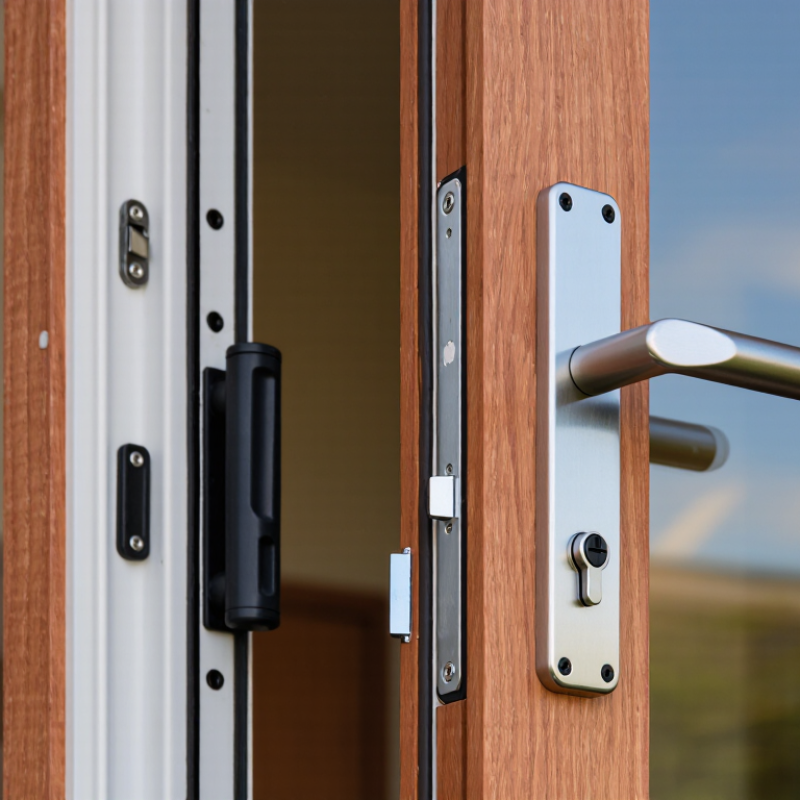
Why Do Door and Window Hardware Need Certifications?

Which Standards Govern Door and Window Hardware Certification?

Door and window hardware certification depends on the product, its use, and the market. In North America, ANSI/BHMA A156 standards cover hardware performance, including locks, hinges, and exit devices. They set test methods for factors such as operating cycles, strength, and corrosion resistance. A certificate should identify the exact product and grade—not just say “tested.”

Standards differ. Fire-rated door assemblies are commonly tested to UL 10C or NFPA 252, while hardware must also be suitable for the rated assembly. For windows, NAFS—AAMA/WDMA/CSA 101/I.S.2/A440—addresses performance such as air, water, and structural resistance. ASTM E330 tests structural performance under uniform pressure. In Europe, EN 1935 covers hinges, while EN 1125 addresses panic exit devices. A standard defines requirements; independent certification programs verify results, and some include factory follow-up.

The stakes are practical. NFPA’s “Fire Loss in the United States During 2021” reported 1,353,500 fires and 3,800 civilian fire deaths that year. Those figures do not show that certified hardware alone prevents casualties, but they underline why tested assemblies and dependable operation matter. Check the certificate’s scope, test standard, rating, and installation limits. A label can be easy to misread. Certification also cannot fix a poorly fitted door or neglected maintenance.

How EN 1935 Rates Hinges: Grade 7 Requires 200,000 Cycles

A hinge may look simple, but every opening puts its pin, knuckle, and fixings under repeated stress. EN 1935 gives this performance a measurable benchmark. In CEN’s EN 1935:2002 classification, Grade 7 is the highest durability class and requires 200,000 test cycles. One cycle means opening and closing the hinge.

That is demanding. At 20 cycles each day, 200,000 cycles equal about 27 years on paper. Real doors vary: a busy school entrance may move far more often than a quiet bedroom door. A cycle rating is not a lifespan promise. That gap is easy to overlook.

When reviewing a test report, check that the tested hinge matches the intended door’s size and weight category. Also look for the stated cycle result and test conditions, not just a grade printed on a product sheet. The EN 1935 rating helps compare hinges under a defined test, but installation quality, alignment, and maintenance still matter. A hinge fitted slightly out of line can wear unevenly, even if its laboratory result is strong.

Why Do Door and Window Hardware Need Certifications?

EN 1935 classifies hinges by performance. Its durability grades indicate the number of cycles completed in standardized testing.

Grade 7 is tested for 200,000 cycles; Grade 4 is tested for 25,000 cycles. Test-cycle counts are standardized durability measures, not a guarantee of service life.

How EN 13126 Classifies Window Hardware Performance

EN 13126 is a series of European standards for window hardware, with different parts covering specific products such as hinges, handles, and locking devices. Its classification system gives buyers and specifiers a structured way to compare tested performance. The code is not a general quality score. Each part sets relevant requirements and test methods.

Depending on the hardware type, classification can address factors such as category of use, durability, test load, corrosion resistance, and security. These details matter in real settings. A window exposed to coastal air may need stronger corrosion performance than one in a dry interior. A heavy sash also places different demands on hinges than a small ventilation window. Small differences matter.

Read the classification alongside the product’s intended application and the relevant part of EN 13126. A result from one test does not prove suitability for every window or climate. Nor does a standard reference alone confirm independent certification; check the test report and certification scope. That distinction is easy to miss. Even a well-labelled component can be mismatched if its load rating, fixing method, or exposure conditions do not fit the actual installation.

Why Do Door and Window Hardware Need Certifications? — How EN 13126 Classifies Window Hardware Performance
Classification field What it describes Why it matters when comparing hardware What to check in the documentation
Category of use The intended use category assigned under the applicable EN 13126 classification scheme. Helps identify whether the hardware is assessed for its intended type and frequency of use. Check the declared classification and confirm that it applies to the product type and relevant part of EN 13126.
Durability Performance related to repeated operating cycles, assessed using the test requirements for the relevant hardware product. Repeated opening and closing can affect operation over time; test results help compare products against a defined method. Look for the tested cycle rating or durability classification stated in the relevant test report or product documentation.
Test mass or load The mass or load range used in testing, where this field applies to the hardware type. Hardware must be suitable for the sash or window configuration and load it is intended to support. Compare the documented test range with the actual sash mass and the hardware manufacturer’s permitted application.
Fire resistance A classification field in the EN 13126 coding system where applicable; it does not, by itself, establish fire performance for every assembly. Fire performance depends on the complete window or door assembly and the applicable fire-test requirements. Check whether the field is applicable and seek assembly-level evidence where a fire-resistance claim is required.
Safety in use Safety-related performance identified by the applicable classification and product-specific test requirements. Supports assessment of risks associated with hardware operation and use. Review the relevant product-part standard, test evidence, and any installation or use limitations.
Corrosion resistance Resistance to corrosion assessed using the methods and classification applicable to the hardware product. Environmental exposure can affect appearance, operation, and service life, particularly in demanding locations. Check the stated corrosion classification and whether it matches the intended environment and finish requirements.
Security A security-related field within the classification scheme, where applicable to the hardware and relevant product part. Helps distinguish hardware assessed for security-related performance from hardware with no such declared classification. Confirm the exact security claim and check whether additional system-level testing or requirements apply.
Application The application field identifies the intended hardware configuration or method of application within the classification system. Correct application is essential: a tested result should not be assumed to cover a different window type or installation. Match the declared application to the window design, opening method, installation, and relevant EN 13126 part.
Product-specific requirements EN 13126 is a series of standards. The applicable part sets requirements and test methods for particular types of window hardware. A classification is meaningful only when read alongside the correct product-specific standard and its test scope. Check the standard part, edition, product description, tested configuration, and any stated limitations.
Certification and evidence A classification or test report records performance against specified requirements; third-party certification is a separate conformity-assessment arrangement. Clear evidence helps specifiers and buyers verify what was tested without treating every test report as a certificate. Verify the issuer, scope, standard edition, product identification, and validity of any certificate or test report.

Important: EN 13126 covers building hardware for windows and door-height windows; it is not a blanket rating for every type of door hardware. Classification fields and requirements can vary by product and applicable standard part. Always check the relevant edition and product-specific documentation.

How EN 1627 Defines Six Burglary-Resistance Classes, RC1–RC6

EN 1627 groups doors, windows, and related building elements into six resistance classes, from RC1 to RC6. Each class describes how a complete unit performs under defined test conditions. The frame matters. So do the glazing, locks, hinges, fixings, and installation.

RC1 offers basic resistance to physical force, while RC2 addresses opportunistic attempts using simple tools. RC3 tests resistance to tools such as a crowbar. RC4 raises the challenge to heavier tools, and RC5 and RC6 involve increasingly powerful tools and more demanding attack methods. These are not simple ratings for a lock alone. A strong lock fitted into a weak frame may not deliver the performance expected from the tested assembly.

The class can help specifiers compare products, but it is not a promise of a specific delay during every real break-in. Tests use controlled methods; actual buildings vary. Installation quality can be overlooked. That matters. Check that the tested configuration matches the intended door or window, including its size, hardware, and glazing. A certification label is useful evidence, but the details behind it deserve a closer look.

How EN 1634-1 Tests Fire Resistance in Door Assemblies

EN 1634-1 evaluates how a complete doorset or shutter assembly performs when exposed to fire. It is not a simple test of a handle or hinge in isolation. Small details matter. A specimen is fitted into a representative supporting wall, then exposed to a controlled furnace temperature curve. Test staff record whether flames or hot gases pass through and how quickly the unexposed face heats. Depending on the test and classification, integrity, insulation, or radiation performance may be reported.

The result applies to the tested configuration: door leaf, frame, seals, glazing, hinges, latch, closer, and fixing method. Changing one part can affect performance, even when a replacement looks equivalent. Not just the leaf. The test records performance over time, such as 30 or 60 minutes, under defined conditions. Those results describe laboratory performance, not a guarantee that every installed door will behave identically in a real fire.

When selecting hardware, check that the test evidence and classification cover the exact doorset arrangement, including dimensions and fitting instructions. A test report is useful, but it cannot make up for poor installation or maintenance. Site conditions are rarely perfect; damaged seals, loose screws, or a misaligned closer can undermine protection. Ask what evidence supports a proposed substitution instead of assuming “fire-rated” means universally compatible.

FAQS

What does Grade 7 mean under EN 1935?

Grade 7 is the highest durability class described in the article. It requires 200,000 test cycles. Not a lifespan promise.

What counts as one hinge test cycle?

One cycle means opening and closing the hinge once. Repeated movement stresses the pin, knuckle, and fixings.

How long might 200,000 cycles represent in daily use?

At 20 cycles per day, that equals about 27 years on paper. A busy entrance may see much heavier use.

What should I check in a hinge test report?

Check the cycle result, test conditions, and tested size and weight category. A grade alone leaves gaps.

What does EN 1634-1 assess?

It tests a complete doorset or shutter assembly exposed to a controlled furnace. Small details matter.

Which parts can affect a fire test result?

The result covers the tested leaf, frame, seals, glazing, hinges, latch, closer, and fixing method. Not just the leaf.

Can I replace a tested hinge with one that looks equivalent?

Appearance alone does not confirm compatibility. Ask for evidence covering the exact doorset arrangement and fitting instructions.

Do laboratory results guarantee the same performance on site?

No. Poor alignment, loose screws, damaged seals, or a misaligned closer can undermine performance. I might overread a test number if I ignore installation.

Conclusion

Door and window hardware certifications provide a consistent way to assess durability, performance, security, and fire resistance. What certifications should door and window hardware have depends on how and where it will be used. EN 1935 classifies hinges by performance, with Grade 7 requiring testing for 200,000 operating cycles. EN 13126 covers window hardware and evaluates factors such as operation, strength, and durability, helping users compare products against defined performance criteria.

Security and fire tests address different risks. EN 1627 sets out six burglary-resistance classes, from RC1 to RC6, indicating increasing resistance to attempted intrusion. EN 1634-1 tests fire resistance in complete door assemblies, rather than treating the hardware as an isolated component. Together, these standards help specify hardware suited to its intended application and support informed decisions about reliable, secure, and fire-resistant door and window systems.

Madeline

Madeline

Madeline is a dedicated marketing professional with a wealth of expertise in our company's core offerings. With a keen understanding of the industry, she brings a unique perspective to her role, consistently delivering high-quality content that highlights the superior aspects of our products. As......