A secure window is not defined by glass alone. Its hinges, handles, locks, and keeps determine how firmly the sash stays in place. A loose handle can leave a visible gap, while a weak hinge may let a heavy sash sag. Small parts matter. Why is proper fitting important for window security? Correctly matched fittings help resist forced movement, support smooth closing, and keep locking points aligned during daily use. But performance depends on more than a label on a box. Material, corrosion protection, load capacity, installation quality, and routine checks all deserve attention.
China’s window hardware sector offers a wide range of products, manufacturing options, and fittings for different frame systems. Buyers should still request clear specifications, sample testing, quality records, and warranty details. Those are more useful than a bold “best” claim. A fitting that looks solid in a catalogue may disappoint on a drafty or coastal site. This is easy to overlook. Check the fit. For homeowners, fabricators, and project teams, a sound choice matches each component to the window’s weight, opening style, exposure, and expected use. Ask how the locking points engage, whether replacement parts are available, and how installation is checked. Even a good checklist can miss a detail. No fitting removes every risk, but dependable hardware, properly installed and maintained, can make a window more secure and reliable every day.
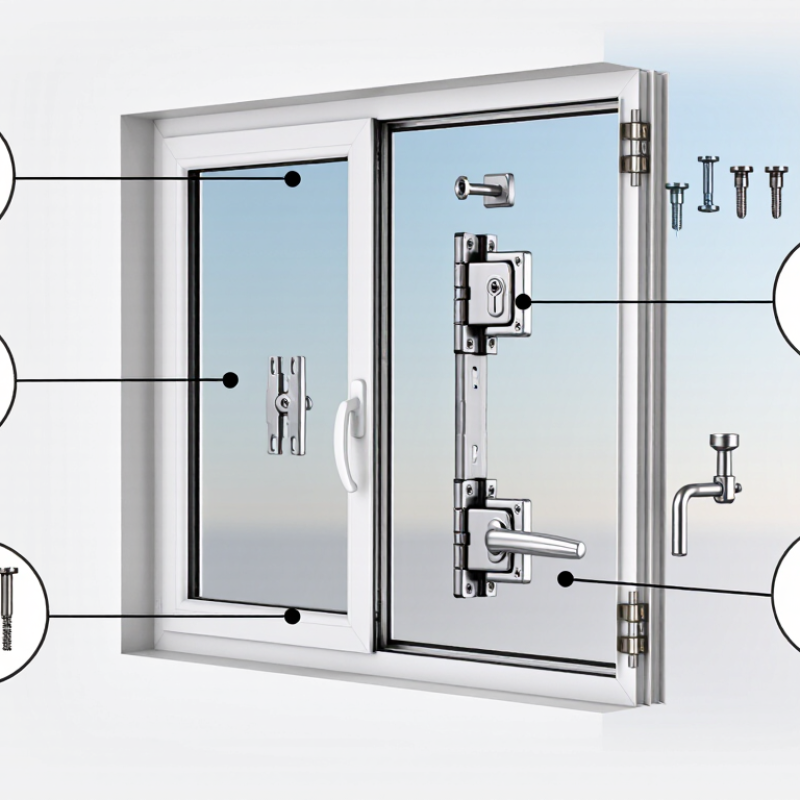
Window fittings are the working security system, not decorative extras. A multipoint lock engages the frame at several positions, reducing the leverage available at one point. Hinges carry the sash; reinforced hinge-side plates help resist prying. Keepers and strike plates matter too. If screws bite only into thin trim, strong-looking hardware may offer little resistance. Small parts matter.
The FBI’s 2019 Crime in the United States report recorded forcible entry in 55.7% of reported burglaries; unlawful entry without force accounted for 36.2%. That distinction helps explain why lock engagement and frame attachment deserve attention, though fittings cannot prevent every break-in.
AAMA/WDMA/CSA 101/I.S.2/A440-22 provides performance requirements for window assemblies, including structural performance; buyers should check tested ratings, not rely on handle appearance alone. In practice, inspect that the sash closes evenly, locking points align, and hinges have no movement.
A restricted-opening device can limit opening width, but it is not a substitute for a secure lock. Honestly, installation is often the weak link. Even well-rated hardware can underperform when a frame is out of square or fasteners are too short.
EN 1627 groups window and door products into six resistance classes, from RC1 to RC6. Each class represents a different level of resistance under defined testing conditions. The classification applies to the complete assembly, not to a handle or hinge on its own. Frame strength, locking points, glazing retention, and installation all matter.
RC2 RC2 is tested against opportunistic attempts using simple tools, with three minutes of active attack time.
RC3 RC3 raises the challenge to more determined attempts using additional tools, with five minutes of active attack time.
These figures describe attack time during testing, not the total test duration or a guaranteed delay in every real situation.
A stopwatch can mislead.
For a practical comparison, check that the test report covers the same window type, opening direction, and hardware configuration you plan to buy. Look closely at how the sash locks into the frame; several secure contact points can help resist levering. Installation deserves equal attention. A strong product fitted poorly may not perform as tested. Even good documentation can leave questions, so confirm the certified configuration with the supplier.
Security depends on the connection between a window’s sash and frame, not on a lock name alone. The FBI’s Crime in the United States 2019 report classified 55.7% of burglaries as forcible entry. That makes the sash-to-frame connection especially important. On a closed window, hooks or mushroom cams pull the sash toward the frame at several points. This spreads load and limits local flex, though resistance depends on the complete assembly. Small details matter. Strike plates must align, and screws need sound framing behind them.
Reinforced hinges address another weak point: the pivot side. Thicker hinge leaves, secure fasteners, and a well-supported frame help keep the sash from twisting under prying force. ASTM International’s F588 test method evaluates window-assembly resistance to forced entry; it is a useful benchmark, not a guarantee. When comparing China-made window fittings, request test reports for the exact hardware and window configuration. Hardware tested alone may not represent the installed window. Glass, frame material, installation gaps, and fastener length all affect performance. Even good fittings can disappoint. Specifications can look reassuring on paper; installation quality is easy to underestimate.
Why Choose China Best Window Fittings for Security?
EN 13126 is a series of European standards for hardware used on windows and door-height windows. It sets out test methods and performance requirements for different fitting types, such as hinges, handles, and locking devices. The exact tests depend on the relevant part of the series. That matters. A hinge and a handle do not face identical demands.
Testing may examine factors such as durability, operating forces, and resistance to environmental exposure. Classification results help buyers compare declared performance, rather than relying on appearance or vague claims. For security, check the specific hardware component, its test evidence, and how it works with the complete window system. A strong lock can still perform poorly if installation is careless or the frame is unsuitable. Details matter.
EN 13126 is useful, but it is not a universal guarantee against intrusion. Nor does one classification prove every product suits every building. Ask for the applicable standard part, the classification, and supporting test documentation. Then compare those details with the window’s intended use and local conditions. Cold air, frequent use, and poor adjustment can change real-world performance. A specification can look reassuring on paper. Installation deserves equal attention.
EN 13126-1 uses an eight-field classification code to describe window hardware characteristics. The chart shows the fields in code order; the numbers indicate sequence, not performance scores.
The classification covers use, durability, test mass, fire resistance, safety in use, corrosion resistance, security and application. Security is one field within the broader classification; check the product’s declared classification and relevant test evidence when comparing hardware.
Why Choose China Best Window Fittings for Security?
How to Compare Chinese Suppliers Using Test Reports and Traceability
Security depends on more than a strong-looking handle. Hinges, locking points, and fasteners must work together under repeated use. When comparing Chinese suppliers, ask for test reports tied to the exact fitting model and material. Check the test date, sample description, method, and laboratory details. A report for a similar product is not enough.
Look for results on load, cycling, corrosion, and operating force where relevant to the fitting. Read the conditions, not just the pass mark. For example, a corrosion result means little if the coating or test duration is unclear. Ask whether the tested sample came from regular production. Small differences matter. A thicker-looking finish may conceal inconsistent base material.
Traceability should connect each shipment to a batch number, material records, and inspection data. Request a sample label and see whether its code matches the paperwork. Then ask how defects are recorded and how corrective actions reach later batches. Good answers are specific. Vague promises are not. I would still inspect samples and confirm fit with the intended window profile; documents cannot show every installation issue. That extra check takes time, but skipping it can be costly.
| Comparison dimension | What to request from each supplier | How to compare the evidence | Why it matters for security |
|---|---|---|---|
| Product and test scope | A report identifying the tested fitting set, product model, materials, configuration, and applicable test standard and edition. | Check that the report covers the exact fitting type and configuration being quoted—not merely a similar product or a general catalogue range. | A result for one configuration does not automatically establish the performance of a different set of hinges, locking points, or handles. |
| Applicable hardware testing | Where relevant, reports to the applicable parts of EN 13126, which covers building hardware for windows and door-height windows. EN 13126-1 provides general requirements and test methods; EN 13126-8 applies to specified tilt-and-turn, tilt-first, and turn-only hardware. | Compare the standard part, edition, test specimen, stated classification, and any limitations. Confirm that the selected part of the standard matches the product type. | Relevant, configuration-specific testing provides a more useful basis for comparing operation and durability than an unsupported “security grade” claim. |
| Operating durability | Cycle-test results and the test method used. EN 1191 is a resistance-to-repeated-opening-and-closing test method for windows and doors; EN 12400 classifies mechanical durability for windows and pedestrian doorsets. | Compare the tested assembly, cycle result or classification, test conditions, and any maintenance assumptions. Do not treat a cycle count as a burglary-resistance rating. | Durable operation can help the fittings continue to work as intended, but it does not by itself demonstrate resistance to forced entry. |
| Burglary-resistance claims | If a security class is claimed, request the relevant test documentation for the complete window or doorset assembly. EN 1627 addresses burglar resistance of pedestrian doorsets, windows, curtain walling, grilles, and shutters. | Verify that the tested frame, glazing, locks, fittings, installation details, and specimen dimensions correspond to the proposed finished system. A fittings-only report is not proof that the complete window meets an EN 1627 class. | Burglary resistance depends on the assembled product and its installation, not on hardware in isolation. |
| Test laboratory and report verification | The full report, laboratory name, report number, issue date, scope of testing, and accreditation details where applicable. | Check report authenticity with the issuing laboratory. Confirm that the laboratory’s accreditation scope covers the relevant test method; accreditation should not be assumed from a logo alone. | Verifiable reports make it easier to distinguish independent test evidence from marketing claims. |
| Material and component records | Material specifications and, where applicable, inspection or test records for critical components such as locking points, keeps, hinges, and fasteners. | Compare documented material grades, dimensions, coatings, and acceptance criteria against the product specification. Ask how substitutions are controlled. | Documented component control helps identify changes that could affect fit, corrosion resistance, or mechanical performance. |
| Batch and lot traceability | A sample production record linking finished-goods batch or lot numbers to production dates, inspection records, and relevant component or material batches. | Check that the supplier can trace a delivered item back through its production and inspection records and can identify affected lots if a defect is found. | Traceability supports targeted investigation and corrective action; it is more useful than an unlinked quality certificate. |
| Production inspection and change control | Inspection plans, recorded checks, nonconformity procedures, and a process for notifying customers of changes to materials, tooling, or product design. | Compare the documented checks and records for the quoted product. Confirm whether changes trigger review or retesting where performance may be affected. | A tested sample is most meaningful when routine production remains controlled and significant changes are managed. |
| Installation and compatibility | Installation instructions, compatible profile and sash details, fixing requirements, adjustment guidance, and the limits of use. | Compare the instructions with the intended window system and confirm that the tested configuration can be reproduced during installation. | Incorrect fixing or incompatible components can undermine the performance of otherwise suitable fittings. |
| Overall supplier assessment | A matched set of product-specific reports, traceable production records, written specifications, and clear answers to technical questions. | Compare evidence completeness and consistency rather than relying on price, a single certificate, or an unqualified security claim. Record missing documents as open items. | The strongest comparison is based on verifiable evidence for the exact product and its intended application. |
Note: Standards, editions, product classifications, and regulatory requirements vary by market and product type. Confirm the applicable requirements with the project specifier or qualified testing body before purchase.
It classifies complete window and door assemblies from RC1 to RC6. The frame, glazing retention, locks, and installation all matter.
RC2 has three minutes of active attack time during testing. RC3 has five. These are not guaranteed delays in real situations.
No. It refers to active attack time, not total test duration. A stopwatch can mislead.
Check the window type, opening direction, and hardware configuration. They should match the product you plan to buy.
Several contact points can help resist levering. Poor fitting may reduce performance, even with a strong product.
It sets test methods and performance requirements for window hardware, including hinges, handles, and locking devices.
No. The relevant tests depend on the hardware type and standard part. A hinge and a handle face different demands.
No. It helps compare declared performance, but does not guarantee resistance to intrusion. Check the test evidence and complete window system.
Ask for the applicable standard part, classification, and supporting documents. Also consider frequent use, cold air, and adjustment. Paperwork is not the whole story.
Window fittings are the components that help a window close securely, resist tampering, and remain reliable in daily use. Why is proper fitting important for window security? Because even strong glass can be vulnerable if locks, hinges, and connecting parts are poorly matched or installed. Multi-point locks secure a sash at several points, while reinforced hinges make it harder to force the window away from its frame. Under EN 1627, resistance is grouped into six RC classes; RC2 and RC3 include defined resistance times of three and five minutes, respectively, during specified attack tests.
EN 13126 evaluates window hardware performance, including aspects such as durability, strength, and operation. When comparing Chinese suppliers, buyers can review relevant test reports, confirm that the tested products match the items offered, and check whether materials and production batches can be traced. These steps help assess whether fittings are suitable for the intended window system and security requirements.

Jefort Hardware